6 Tips from IDEO Designers on How to Unlock Insightful Conversation - IDEO U
1. Always say yes to an offer. Whether the other person offers you a glass of water, snacks, or even a tour of their home, you should always accept.
2. Wear generic clothing. Oftentimes, clothing can communicate social status, or reflect personal taste that others may disagree with.
3. Treat people like partners in research. The people you interview aren’t just research subjects or data points.
4. Leave comfortable silences. When it seems like the other person is done speaking … you should create some space by just nodding and writing things down —it gives the other person room to continue speaking beyond…
5. Take the spotlight off the other person. …we like to bring provocations into research sessions. …sketch out rough concepts to show the other person, and ask them for feedback.
6. Try very intentionally to fall in love with each person (even if it’s just a little bit). Even if you don’t naturally click with someone, you can always find something you truly appreciate about them, whether it’s their voice or their passion for the topic at hand.
Mostrando entradas con la etiqueta culturilla. Mostrar todas las entradas
domingo, 16 de julio de 2017
viernes, 17 de marzo de 2017
Sala de (Reuniones) Decisiones
via @sintetia – Reunir y decidir, esa es la cuestión por @fabadiabadenas
– ¡Cielos! ¿No se lo han explicado?
– No.
– El soberano jamás ofrece a un Primer Ministro un refresco ni una silla. El precedente lo estableció su Tatarabuela al mantenernos de pie como Ayudas de Cámara. Perder el tiempo es un pecado mortal. Si algo he aprendido en cincuenta y dos años de servicio público, es que no hay problema tan complejo, no hay crisis tan grave que no se pueda resolver satisfactoriamente… en veinte minutos. ¡Bien, podemos empezar!
Primer despacho privado entre la Reina Isabel II de Inglaterra y el Primer Ministro Winston Churchill.
Como dice Carolyb B. Thompson, “Una reunión no es más que un montón de cuerpos si no unen sus mentes”.
*Ideas extraídas del libro –“Gestionar Reuniones es fácil” de Barbara J. Streibel– y de las cientos y cientos de reuniones a las que he asistido.
1.- Utiliza las reuniones con inteligencia.
2.- Decide si la reunión es necesaria.
3.- Programa, programa y programa.
4.- Dirigir la reunión.
5.- Tomar una decisión.
6.- Cerrar la reunión.
7.- Redactar el acta.
8.- Trabajar y mejorar.
9.- Evaluar. La última tarea de una reunión sería mejorar las reuniones futuras.
Etiquetas:
citas,
cosillas empresariales,
culturilla,
curiosidades agradables,
política
domingo, 19 de febrero de 2017
Trump y los negocios en USA
algunas notas de la interesante charla en la Fundación de Estudios Bursátiles y Financieros "La era Trump y los negocios en USA" (a cargo de Ramón Trénor, de Garrigues NYC).
GANADORES
Farmacéuticas (por derogación Obama care)
Gas y petróleo (se quiere utilizar para potenciar la "reactivación industrial")
Infraestructuras (se quiere invertir en ellas)
Defensa (parque obsoleto)
Prestadores de servicios –outsourcers– (privatización cárceles)
PERDEDORES
Telecom y Media (mercados lat-am)
Renovables … dijo que es "cara y mata muchos pájaros" (no parece que eso les brinde un brillante futuro)
Automóviles con mucha fuerza de coreanos, japoneses y europeos (muchas piezas se hacen en México, si van a tener que importarse con arancel… mal; si consigue repatriar la producción, quizá no tan mal futuro)
México
50%
Banca y Aseguradoras (liberalización de comisiones, pero problemas en su crecimiento en lat-am)
Aerolíneas y navieras
Retail y consumidor
Lo divertido y alternativo ya no es pedir cerveza artesana, sin Coca Cola mexicana
Refugiados: Reducción a 50.000 (el problema es que se habla de motivos "religiosos"… y no parece que se hable de todas las religiones)
Va a haber una mayor complejidad en los visados extranjeros para trabajar:
Se quiere hacer desaparecer el H1B (el de los "investigadores" y "científicos" y el de muchos técnicos en Silicon Valley, el de "personas extraordinarias por su conocimiento o preparación")
L1, E1 y E2 se van a complicar – hay que demostrar que la persona es difícil de sustituir por un norteamericano y que va a ser "rentable" para USA
Medidas fiscales: reducción impuestos federales
El muro: se va a cargar un arancel del 20% al producto Mexicano para pagar muro
El presupuesto que baraja Trump los expertos lo multiplican x2 ó x3
La negación de la ratificación TPP que supone el 40% PIB mundial
Quiere renegociar NAFTA
La lucha contra el cambio climático va a dejar se user prioridad y se va a destinar el presupuesto a crear empleo
Amenaza con represalias contra China por manipuladora y debería prestar que tiene la mayor de reserva de deuda americana
Respecto a las reducción de impuestos, ya Stiglitz dice que no entrará tanto como para pagar lo que quiere invertir. Actualmente el tramo mas alto, 40% quiere reducirlo al 33% y dejar dos tramos más de 25% y el 12%
Además quiere reducir el impuesto de sociedades.
Se habla de un nuevo New Deal, aunque el New Deal tuvo muchos cambios y fue un proceso prueba-error. Esa (necesaria) mejora en infraestructuras va a tener costes uy elevados.
GANADORES
Farmacéuticas (por derogación Obama care)
Gas y petróleo (se quiere utilizar para potenciar la "reactivación industrial")
Infraestructuras (se quiere invertir en ellas)
Defensa (parque obsoleto)
Prestadores de servicios –outsourcers– (privatización cárceles)
PERDEDORES
Telecom y Media (mercados lat-am)
Renovables … dijo que es "cara y mata muchos pájaros" (no parece que eso les brinde un brillante futuro)
Automóviles con mucha fuerza de coreanos, japoneses y europeos (muchas piezas se hacen en México, si van a tener que importarse con arancel… mal; si consigue repatriar la producción, quizá no tan mal futuro)
México
50%
Banca y Aseguradoras (liberalización de comisiones, pero problemas en su crecimiento en lat-am)
Aerolíneas y navieras
Retail y consumidor
Etiquetas:
cosillas empresariales,
culturilla,
economía,
el critico como artista,
política
domingo, 10 de enero de 2016
How to Be an Anticapitalist Today
How to Be an Anticapitalist Today | Jacobin
1. Smashing Capitalism
The argument goes something like this: the system is rotten. All efforts to make life tolerable within it will eventually fail. From time to time small reforms that improve the lives of people may be possible when popular forces are strong, but such improvements will always be fragile, vulnerable to attack and reversible.
The idea that capitalism can be rendered a benign social order in which ordinary people can live flourishing, meaningful lives is ultimately an illusion because, at its core, capitalism is unreformable. The only hope is to destroy it, sweep away the rubble, and then build an alternative. As the closing words of the labor tune “Solidarity Forever” proclaim, “We can bring to birth a new world from the ashes of the old.”
…
It is one thing to burn down old institutions; it is quite another to build emancipatory new institutions from the ashes.
Why the revolutions of the twentieth century never resulted in robust, sustainable human emancipation is, of course, a hotly debated matter.
…
To actually transform capitalism, visions that resonate with anger are not enough; instead, a strategic logic that has some chance of actually accomplishing its goals is needed.
2. Taming Capitalism
Here is the basic argument. Capitalism, when left to its own devices, creates great harms. It generates levels of inequality that are destructive to social cohesion; it destroys traditional jobs and leaves people to fend for themselves; it creates uncertainty and risk for individuals and whole communities; it harms the environment. These are all consequences of the inherent dynamics of a capitalist economy.
…
The idea of taming capitalism does not eliminate the underlying tendency for capitalism to generate harms; it simply counteracts their effects. This is like a medicine which effectively deals with symptoms rather than with the underlying causes of a health problem.
…
Globalization has made it much easier for capitalist firms to move investments to places in the world with less regulation and cheaper labor, while the threat of capital flight, along with a variety of technological changes, has fragmented and weakened the labor movement, making it less capable of resistance and political mobilization. Combined with globalization, the increasing financialization of capital has led to massive increases in wealth and income inequality, which in turn has increased the political leverage of opponents of the social-democratic state.
…
3. Escaping Capitalism
Escaping capitalism typically involves avoiding political engagement and certainly of collectively organized efforts at changing the world. Especially in the world today, escape is mostly an individualistic lifestyle strategy.…
Intentional communities may be motivated by the desire to escape the pressures of capitalism, but sometimes they can also serve as models for more collective, egalitarian, and democratic ways of living.…
The Do It Yourself movement and the “sharing economy” may be motivated by stagnant individual incomes during a period of economic austerity, but they can also point to ways of organizing economic activity that are less dependent on market exchange
…
4. Eroding Capitalism
It is grounded in the following idea: all socioeconomic systems are complex mixes of many different kinds of economic structures, relations, and activities.
Existing economic systems combine capitalism with a whole host of other ways of organizing the production and distribution of goods and services: directly by states; within the intimate relations of families to meet the needs of its members; through community-based networks and organizations; by cooperatives owned and governed democratically by their members; though nonprofit market-oriented organizations; through peer-to-peer networks engaged in collaborative production processes; and many other possibilities.
…
The idea of eroding capitalism imagines that these alternatives have the potential, in the long run, of expanding to the point where capitalism is displaced from this dominant role.
…
Real utopias
… turns eu, which means good, and ou, which means no — into “u” and placing this before the Greek word for place, topos.
U-topia is thus the good place that exists in no place. It is a fantasy of perfection.
How then can it be “real”? It may be realistic to seek improvements in the world, but not perfection. Indeed, the search for perfection can undermine the practical task of making the world a better place. As the saying goes, “the best is the enemy of the good.”
There is thus an inherent tension between the real and the utopian. It is precisely this tension which the idea of a “real utopia” is meant to capture. The point is to sustain our deepest aspirations for a just and humane world that does not exist while also engaging in the practical task of building real-world alternatives that can be constructed in the world as it is that also prefigure the world as it could be and which help move us in that direction.
Conclusions
If you are concerned about the lives of others, in one way or another you have to deal with capitalist structures and institutions. Taming and eroding capitalism are the only viable options. You need to participate both in political movements for taming capitalism through public policies and in socioeconomic projects of eroding capitalism through the expansion of emancipatory forms of economic activity.
1. Smashing Capitalism
The argument goes something like this: the system is rotten. All efforts to make life tolerable within it will eventually fail. From time to time small reforms that improve the lives of people may be possible when popular forces are strong, but such improvements will always be fragile, vulnerable to attack and reversible.
The idea that capitalism can be rendered a benign social order in which ordinary people can live flourishing, meaningful lives is ultimately an illusion because, at its core, capitalism is unreformable. The only hope is to destroy it, sweep away the rubble, and then build an alternative. As the closing words of the labor tune “Solidarity Forever” proclaim, “We can bring to birth a new world from the ashes of the old.”
…
It is one thing to burn down old institutions; it is quite another to build emancipatory new institutions from the ashes.
Why the revolutions of the twentieth century never resulted in robust, sustainable human emancipation is, of course, a hotly debated matter.
…
To actually transform capitalism, visions that resonate with anger are not enough; instead, a strategic logic that has some chance of actually accomplishing its goals is needed.
2. Taming Capitalism
Here is the basic argument. Capitalism, when left to its own devices, creates great harms. It generates levels of inequality that are destructive to social cohesion; it destroys traditional jobs and leaves people to fend for themselves; it creates uncertainty and risk for individuals and whole communities; it harms the environment. These are all consequences of the inherent dynamics of a capitalist economy.
…
The idea of taming capitalism does not eliminate the underlying tendency for capitalism to generate harms; it simply counteracts their effects. This is like a medicine which effectively deals with symptoms rather than with the underlying causes of a health problem.
…
Globalization has made it much easier for capitalist firms to move investments to places in the world with less regulation and cheaper labor, while the threat of capital flight, along with a variety of technological changes, has fragmented and weakened the labor movement, making it less capable of resistance and political mobilization. Combined with globalization, the increasing financialization of capital has led to massive increases in wealth and income inequality, which in turn has increased the political leverage of opponents of the social-democratic state.
…
3. Escaping Capitalism
Escaping capitalism typically involves avoiding political engagement and certainly of collectively organized efforts at changing the world. Especially in the world today, escape is mostly an individualistic lifestyle strategy.…
Intentional communities may be motivated by the desire to escape the pressures of capitalism, but sometimes they can also serve as models for more collective, egalitarian, and democratic ways of living.…
The Do It Yourself movement and the “sharing economy” may be motivated by stagnant individual incomes during a period of economic austerity, but they can also point to ways of organizing economic activity that are less dependent on market exchange
…
4. Eroding Capitalism
It is grounded in the following idea: all socioeconomic systems are complex mixes of many different kinds of economic structures, relations, and activities.
Existing economic systems combine capitalism with a whole host of other ways of organizing the production and distribution of goods and services: directly by states; within the intimate relations of families to meet the needs of its members; through community-based networks and organizations; by cooperatives owned and governed democratically by their members; though nonprofit market-oriented organizations; through peer-to-peer networks engaged in collaborative production processes; and many other possibilities.
…
The idea of eroding capitalism imagines that these alternatives have the potential, in the long run, of expanding to the point where capitalism is displaced from this dominant role.
…
Real utopias
… turns eu, which means good, and ou, which means no — into “u” and placing this before the Greek word for place, topos.
U-topia is thus the good place that exists in no place. It is a fantasy of perfection.
How then can it be “real”? It may be realistic to seek improvements in the world, but not perfection. Indeed, the search for perfection can undermine the practical task of making the world a better place. As the saying goes, “the best is the enemy of the good.”
There is thus an inherent tension between the real and the utopian. It is precisely this tension which the idea of a “real utopia” is meant to capture. The point is to sustain our deepest aspirations for a just and humane world that does not exist while also engaging in the practical task of building real-world alternatives that can be constructed in the world as it is that also prefigure the world as it could be and which help move us in that direction.
Conclusions
If you are concerned about the lives of others, in one way or another you have to deal with capitalist structures and institutions. Taming and eroding capitalism are the only viable options. You need to participate both in political movements for taming capitalism through public policies and in socioeconomic projects of eroding capitalism through the expansion of emancipatory forms of economic activity.
Etiquetas:
cosillas empresariales,
culturilla,
educación,
el critico como artista,
hacktivismo,
ideas,
política
domingo, 19 de julio de 2015
Entrepreneur, startups, founders… cuestión de matiz (y moda)
by @bfeld Do We Need A New Word For Entrepreneur? - Feld Thoughts
A raíz del "agotamiento" por exceso de uso del término emprendedor, Brad Feld plantea una serie de ideas interesante sobre la evolución del lenguaje.
In 2010, the Startup America Partnership finally got the US government to separate the notion of "small businesses" and "high growth businesses" The word "startup" was firmly introduced into our lexicon as shorthand for "high growth business" and now is a comfortable one.Esta idea me ha recordado mucho a la entrada del cuento sobre 2 emprendedores.
For example, I think we are finally starting to differentiate between local businesses (your local restaurant, coffee shop, bookstore, gas station, movie theater, clothing store, art store, or anything else that sells to your local community) from a startup business (a company that might be small, but is selling to anyone anywhere in the world). …
And then there are a several words trying to characterize different stages of startups. A scaleup is a startup that is scaling quickly. A gazelle, a word that has been around for a while and is becoming popular again, is a startup that has achieved critical mass and is a rapidly growing company, kind of like a scaleup, but falling comfortably into the animal taxonomy that seems to include unicorns and dragons.Estas otras ideas me recuerdan el impresionante post de Paul Graham que habla también sobre que no es startup si no puede crecer MUCHO.
Etiquetas:
cosillas empresariales,
culturilla,
economía,
el critico como artista,
start-it-up
domingo, 15 de febrero de 2015
¿Arte sin artistas?
¿Arte sin artistas? – El Correo de Las Indias, David de Ugarte
La idea moderna del «artista» nace con el humanismo renacentista. El que hasta entonces había sido un mercader y artesano, dueño y especialista de un saber que se reproducía y producía colectivamente en un taller-empresa, el Arte, empieza a ser considerado «creador». Es decir, un émulo individual de la divinidad de la cual participa a través de la «inspiración», otro concepto de la mística judeocristiana.
Entre el «maestro del Arte» y el artista hay un salto no solo en las formas de organización, sino en la concepción del trabajo. El maestro es el responsable de un taller que hace productos, el artista no es que renuncie al taller -al contrario, en ciertos momentos se masificará- pero se presenta como el responsable único de las «obras». El nuevo personaje pretende aportar esa «chispa divina» que supuestamente caracterizaría al verdadero «Arte» convirtiéndolo en algo «sin precio». Así que con el discurso individualista y místico del «creador» nace también el relato descalificador de la «artesanía», ese muñeco sin alma, del que solo se puede esperar que sea burdo y pobretón, mercancía inane que no tuvo el toque divino de un verdadero artista.
…El pintor renacentista y barroco aspira al privilegio real, a la «patente», algo extraordinario que ha de ser justificado frente al poder.…
En la vida comunitaria uno se da cuenta pronto de que la habilidad para hacer aportes creativos no se hereda genéticamente. Solo depende, como pensaban los artesanos medievales, de la propia capacidad para superarse y hacerse responsable de aprender. Luego, el aporte de cada cual es distintivo, diferente. Evidentemente, hay personas con más capacidad que otras en el manejo de una técnica determinada.
Este carácter, cooperativo con los demás y básico en la vida de cada uno, seguramente se hizo evidente antes en el mundo igualitario de las comunidades que en el «mundo del arte» donde las rentas impulsaban los discursos del «genio». Seguramente por eso, las comunidades igualitarias han expandido la lógica creativa del arte a más y más facetas de la experiencia cotidiana, disolviendo al mismo tiempo la figura del «artista».
La idea moderna del «artista» nace con el humanismo renacentista. El que hasta entonces había sido un mercader y artesano, dueño y especialista de un saber que se reproducía y producía colectivamente en un taller-empresa, el Arte, empieza a ser considerado «creador». Es decir, un émulo individual de la divinidad de la cual participa a través de la «inspiración», otro concepto de la mística judeocristiana.
Entre el «maestro del Arte» y el artista hay un salto no solo en las formas de organización, sino en la concepción del trabajo. El maestro es el responsable de un taller que hace productos, el artista no es que renuncie al taller -al contrario, en ciertos momentos se masificará- pero se presenta como el responsable único de las «obras». El nuevo personaje pretende aportar esa «chispa divina» que supuestamente caracterizaría al verdadero «Arte» convirtiéndolo en algo «sin precio». Así que con el discurso individualista y místico del «creador» nace también el relato descalificador de la «artesanía», ese muñeco sin alma, del que solo se puede esperar que sea burdo y pobretón, mercancía inane que no tuvo el toque divino de un verdadero artista.
…El pintor renacentista y barroco aspira al privilegio real, a la «patente», algo extraordinario que ha de ser justificado frente al poder.…
En la vida comunitaria uno se da cuenta pronto de que la habilidad para hacer aportes creativos no se hereda genéticamente. Solo depende, como pensaban los artesanos medievales, de la propia capacidad para superarse y hacerse responsable de aprender. Luego, el aporte de cada cual es distintivo, diferente. Evidentemente, hay personas con más capacidad que otras en el manejo de una técnica determinada.
Este carácter, cooperativo con los demás y básico en la vida de cada uno, seguramente se hizo evidente antes en el mundo igualitario de las comunidades que en el «mundo del arte» donde las rentas impulsaban los discursos del «genio». Seguramente por eso, las comunidades igualitarias han expandido la lógica creativa del arte a más y más facetas de la experiencia cotidiana, disolviendo al mismo tiempo la figura del «artista».
Etiquetas:
culturilla,
curiosidades agradables,
ideas,
la vida misma,
sociología,
tendencias
sábado, 17 de enero de 2015
10 great NYC museums you didn't know were free
No es que vaya mucho a Nueva York, pero creo que será buena idea prepararse "just in case"
10 great NYC museums you didn't know were free - Freelancers Union
Etiquetas:
culturilla,
curiosidades agradables,
lugares
jueves, 1 de enero de 2015
Nuevo arte, nuevos artistas, nuevo renacimiento & freelancers
Mi media naranja está en una etapa compleja… licenciada en Bellas Artes el pasado junio (2014), se abre una etapa de definir qué quiere hacer; con increíbles capacidades para la venta (a lo que se ha dedicado profesionalmente muchos años), el arte, el dibujo, la pintura, la escultura, la venta, el 3D, la animación, la edición de vídeo, la escritura… su problema (¿nuestro?) es que no sabe "como vender" esas bondades. Por supuesto mi apoyo y consejo no le es de utilidad ¿cuándo ha funcionado entre parejas la "consultoría"?
A mi me ha dado por decirle que explote sus habilidades artísticas, sin duda ayuda que ella manifieste que disfruta mucho cuando pinta, pero en serio que aunque sea un mundo complejo (el de la comercialización del arte) me parece que es algo que todavía no se puede digitalizar. Un lienzo siempre será un lienzo. Una escultura siempre es una escultura. Es el último "Bastión" de la autenticidad.
How to be good at everything: tips from renaissance freelancers - Freelancers Union
…freelancing is on the rise. Nearly 1 in 3 workers, to be … nearly ever field and every profession is going rogue. But with this new workforce comes an entirely new phenomenon: the renaissance freelancer.
…but there’s also a creative flow surrounding the renaissance freelancer. Are they born that way? Or is it just another case of “necessity is the mother of invention”? Turns out, it’s a little bit of both.
…“I’ve kind of made all my ‘not work things’ into businesses now,”…
…Cole’s personal blog allows her to combine all passions at once, so you can see her not only looking fabulous in the vintage clothes from her shop, but also hear her music, get recipes for her vegan delicacies and see her photography skills…
Fueled by creativity and rarely afraid to try new things, the renaissance freelancer does seem to have just a little more of an energy about them than most people. And, not surprisingly, each of the freelancers interviewed seemed to have one more thing in common: a deep-rooted love of their downtime. One can only assume because they have so very little of it.
Pronounce the word artist, to conjure up the image of a solitary genius. A sacred aura still attaches to the word, a sense of one in contact with the numinous. “He’s an artist,” we’ll say in tones of reverence about an actor or musician or director. “A true artist,” we’ll solemnly proclaim our favorite singer or photographer, meaning someone who appears to dwell upon a higher plane. …
Before we thought of artists as geniuses, we thought of them as artisans. The words, by no coincidence, are virtually the same. Art itself derives from a root that means to “join” or “fit together”—that is, to make or craft…
Creativity was prized, but credibility and value derived, above all, from tradition. In a world still governed by a fairly rigid social structure, artists were grouped with the other artisans, somewhere in the middle or lower middle, below the merchants…
…The age of revolution, it was also the age of secularization. As traditional belief became discredited, at least among the educated class, the arts emerged as the basis of a new creed, the place where people turned to put themselves in touch with higher truths.
Art rose to its zenith of spiritual prestige, and the artist rose along with it. The artisan became the genius: solitary, like a holy man; inspired, like a prophet; in touch with the unseen, his consciousness bulging into the future.
…By the modernist moment … the artist stood at the pinnacle of status, too, a cultural aristocrat with whom the old aristocrats—or at any rate the most advanced among them—wanted nothing more than to associate.
…After World War II in particular, and in America especially, art, like all religions as they age, became institutionalized. We were the new superpower; we wanted to be a cultural superpower as well. We founded museums, opera houses, ballet companies, all in unprecedented numbers: the so-called culture boom. Arts councils, funding bodies, educational programs, residencies, magazines, awards—an entire bureaucratic apparatus.
As art was institutionalized, so, inevitably, was the artist. The genius became the professional. Now you didn’t go off to Paris and hole up in a garret to produce your masterpiece, your Les Demoiselles d’Avignon or Ulysses, and wait for the world to catch up with you. Like a doctor or lawyer, you went to graduate school—MFA programs were also proliferating—and then tried to find a position. …
Expertise—or, in the mantra of the graduate programs, “technique”—not inspiration or tradition, became the currency of aesthetic authority. The artist-as-genius could sometimes pretend that his work was tossed off in a sacred frenzy, but no self-respecting artist-as-professional could afford to do likewise. They had to be seen to be working, and working hard …
The artist’s progress, in the postwar model, was also professional. You didn’t burst from obscurity to celebrity with a single astonishing work. You slowly climbed the ranks. You accumulated credentials. You amassed a résumé. … It was safer than the solitary-genius thing, but it was also a lot less exciting, and it is no surprise that artists were much less apt to be regarded now as sages or priests, much more likely to be seen as just another set of knowledge workers. …
Artisan, genius, professional: underlying all these models is the market. In blunter terms, they’re all about the way that you get paid. If the artisanal paradigm predates the emergence of modern capitalism—the age of the artisan was the age of the patron, with the artist as, essentially, a sort of feudal dependent—the paradigms of genius and professional were stages in the effort to adjust to it.
…Against the values of the market, the artist, like other professionals, maintained a countervailing set of standards and ideals—beauty, rigor, truth—inherited from the previous paradigm. Institutions served to mediate the difference, to cushion artists, ideologically, economically, and psychologically, from the full force of the marketplace.
…we have entered, unmistakably, a new transition, and it is marked by the final triumph of the market and its values, the removal of the last vestiges of protection and mediation. In the arts, as throughout the middle class, the professional is giving way to the entrepreneur, or, more precisely, the “entrepreneur”: the “self-employed” (that sneaky oxymoron), the entrepreneurial self.
…Now we’re all supposed to be our own boss, our own business: our own agent; our own label; our own marketing, production, and accounting departments. Entrepreneurialism is being sold to us as an opportunity. It is, by and large, a necessity. Everybody understands by now that nobody can count on a job.
Still, it also is an opportunity. The push of institutional disintegration has coincided with the pull of new technology. The emerging culture of creative entrepreneurship predates the web—its roots go back to the 1960s—but the web has brought it an unprecedented salience. The Internet enables you to promote, sell, and deliver directly to the user, and to do so in ways that allow you to compete with corporations and institutions, which previously had a virtual monopoly on marketing and distribution. You can reach potential customers at a speed and on a scale that would have been unthinkable when pretty much the only means were word of mouth, the alternative press, and stapling handbills to telephone poles.
…Creative entrepreneurship is spawning its own institutional structure—online marketplaces, self-publishing platforms, nonprofit incubators, collaborative spaces—but the fundamental relationship remains creator-to-customer, with creators handling or superintending every aspect of the transaction.
So what will all this mean for artists and for art? For training, for practice, for the shape of the artistic career, for the nature of the artistic community, for the way that artists see themselves and are seen by the public, for the standards by which art is judged and the terms by which it is defined? These are new questions, open questions, questions no one is equipped as yet to answer. But it’s not too early to offer a few preliminary observations…
…The truth is that the geniuses weren’t really quite as solitary as advertised. They also often came together—think of the Bloomsbury Group—in situations of intense, sustained creative ferment. With the coterie or circle as a social form, from its conversations and incitements, came the movement as an intellectual product: impressionism, imagism, futurism.
But the network is a far more diffuse phenomenon, and the connections that it typically entails are far less robust. A few days here, a project there, a correspondence over e‑mail. A contact is not a collaborator.
… You were a writer, or a painter, or a choreographer. It is hard to think of very many figures who achieved distinction in more than one genre—fiction and poetry, say—let alone in more than one art. …
But one of the most conspicuous things about today’s young creators is their tendency to construct a multiplicity of artistic identities. You’re a musician and a photographer and a poet; a storyteller and a dancer and a designer—a multiplatform artist, in the term one sometimes sees. …
What we see in the new paradigm—in both the artist’s external relationships and her internal creative capacity—is what we see throughout the culture: the displacement of depth by breadth. Is that a good thing or a bad thing? No doubt some of both, in a ratio that’s yet to be revealed. What seems more clear is that the new paradigm is going to reshape the way that artists are trained. One recently established MFA program in Portland, Oregon, is conducted under the rubric of “applied craft and design.” Students, drawn from a range of disciplines, study entrepreneurship as well as creative practice. …
The new paradigm is also likely to alter the shape of the ensuing career. Just as everyone, we’re told, will have five or six jobs, in five or six fields, during the course of their working life, so will the career of the multiplatform, entrepreneurial artist be more vagrant and less cumulative than under the previous models. No climactic masterwork of deep maturity, no King Lear or Faust, but rather many shifting interests and directions as the winds of market forces blow you here or there.
…
It’s hard to believe that the new arrangement will not favor work that’s safer: more familiar, formulaic, user-friendly, eager to please—more like entertainment, less like art. Artists will inevitably spend a lot more time looking over their shoulder, trying to figure out what the customer wants rather than what they themselves are seeking to say. The nature of aesthetic judgment will itself be reconfigured. …
Judgment rested with the patron, in the age of the artisan. In the age of the professional, it rested with the critic, a professionalized aesthete or intellectual. In the age of the genius, which was also the age of avant-gardes, of tremendous experimental energy across the arts, it largely rested with artists themselves. …
…
“Producerism,” we can call this, by analogy with consumerism. What we’re now persuaded to consume, most conspicuously, are the means to create. And the democratization of taste ensures that no one has the right (or inclination) to tell us when our work is bad. A universal grade inflation now obtains: we’re all swapping A-minuses all the time, or, in the language of Facebook, “likes.”
…we might also say that under producerism, in the age of creative entrepreneurship, producing becomes an experience, even the experience. It becomes a lifestyle, something that is packaged as an experience—and an experience, what’s more, after the contemporary fashion: networked, curated, publicized, fetishized, tweeted, catered, and anything but solitary, anything but private.
…
Creator: I’m not sure that artist even makes sense as a term anymore, and I wouldn’t be surprised to see it giving way before the former, with its more generic meaning and its connection to that contemporary holy word, creative. …
When works of art become commodities and nothing else, when every endeavor becomes “creative” and everybody “a creative,” then art sinks back to craft and artists back to artisans… So “art” itself may disappear: art as Art, that old high thing. …
Etiquetas:
cosillas empresariales,
culturilla,
el critico como artista,
gestión,
ideas,
start-it-up,
tendencias
domingo, 11 de mayo de 2014
Cuando conmueve una obra de arte, conmueve la capacidad del artista para resolver un problema
Al preguntarle por Samuel Morse, quien inventó el telégrafo tras pasarse años intentando ser pintor sin éxito, Lewis afirma:
"Poca gente se da cuenta de que cuando les conmueve una obra de arte, les conmueve la capacidad del artista para resolver un problema que suele ser muy antiguo y atemporal. En el caso de Cézanne, era cómo representar la naturaleza en la pintura. No firmaba el 90% de sus cuadros porque sentía que aún no había resuelto el problema... Todas estas obras distintas son soluciones a problemas. Para algunos no existe una diferencia entre encontrar algo nuevo en el arte y encontrar algo en la tecnología".
Lewis también habla de cómo los intentos por resolver problemas en el arte y la tecnología suelen correr el riesgo de fracasar, y no el tipo de fracaso que aplaude Silicon Valley (en el que los inversores de capital riesgo se niegan a seguir financiando una empresa emergente y los emprendedores se entregan a otro emprendimiento) sino un fracaso profundo, en el que te va "toda la vida".
Este deseo de resolver problemas, común a todos los artistas de verdad, y a los auténticos innovadores …
Etiquetas:
culturilla,
curiosidades agradables,
el critico como artista,
ideas
viernes, 18 de abril de 2014
¿Cómo dirigiría un filósofo tu empresa?
A la Toyota o a la Nintendo… David de Ugarte, en El Correo de Las Indias nos muestra las diferencias entre el platonismo y el estoicismo aplicados a la gestión… mejora continua ó innovación radical
Como en toda buena entrada de un blog, también son interesantes los comentarios…
… Cada producto reproduce el ciclo de la creación divina: comienza en la mente del líder/Dios con una palabra. Cuando pone a todos a trabajar en ello arranca la Historia del producto. Pero la primera versión no es perfecta. Hay un pecado original que ha de corregirse. Y luego otro y otro y otro. En una mejora ciclo a ciclo que conduce, en los límites del tiempo, a la «calidad total», un mítico Edén donde la criatura real se reconcilia finalmente con su creador. Un momento trabajosamente alcanzado y rigurosamente traducido a «procedures» -las nuevas tablas de la ley- a lo largo del tiempo. …
… De hacer naipes no saldrá hacer mejores naipes, más cercanos al ideal platónico de «el naipe», sino juegos sociales, y de los juegos sociales aventuras de rol con pistolas laser, y de ahí consolas de juegos, y de ahí…
… Desde el punto de vista de una empresa, del tipo que sea, la alternativa al platonismo de los ciclos LEAN no puede ser el paso a una relación contemplativa con el mundo. Las empresas tienen que satisfacer necesidades –de sus clientes, de sus propietarios, de los que trabajan en ellas, de la sociedad, del entorno…– y eso no se consigue sin traducir a la práctica (tecnología) lo que se aprende de interactuar con lo que las rodea. Esto es lo que significa innovar: traducir lo aprendido en nuevos usos, productos y herramientas que a su vez permiten aprender más. …
Como en toda buena entrada de un blog, también son interesantes los comentarios…
… Sí, y la cuestión de fondo seguramente sea que no hay «procedure» que a las finales libere a nadie de tener que pensar. Y en una coop, pensar y aprender en común.
La «serenidad» que aporta el procedure es falsa, no consiste en ganar autonomía sino en renunciar completamente a ella, ponerse ojeras y seguir adelante por pura «fe» repitiéndose a uno mismo que, a fin de cuentas puede estar orgulloso porque cada día hace las cosas un poco mejor.
Lo malo es que la «fe» así entendida, la confianza irracional en la mejora incremental, un buen día topa con que el mundo no ha dejado de cambiar… y entonces solo se le ocurre buscar «culpables», a ser posible lejos, en China por ejemplo…
… Veo cada vez más claro que tenemos que seguir el debate por ahí, asociar los modelos de gestión/colaboración imperantes a los modelos filosófico-religiosos que son su base cultural, los moldes en los que se forman… y los valores que transmiten y a partir de ahí discutir alternativas sin perder el foco de los valores a los que cada modelo lleva. …
… Cuando leí el anterior post y éste no puedo evitar relacionarlo con Ingold y el neomaterialismo. A riesgo de alargarme, te copio un trocito de cómo están explicando su trabajo en latinoamérica:
“Ahora bien, si queremos estudiar la participación de nosotros y todas las cosas que habitan el mundo-vida no podemos reducirlo a un modelo ni congelarlo en el tiempo pues siempre estamos en un devenir; un devenir que, por otro lado, no lleva a ninguna finalidad trascendente. El mundo, entonces, no está terminado. Así, las cosas (humanos, animales, plantas, rocas, autos, etc.) están inmersas en este mundo, se desarrollan y tienen diferentes dinámicas”. …
Etiquetas:
cosillas empresariales,
culturilla,
filosofía,
gestión,
lecturas,
psicología
domingo, 9 de febrero de 2014
Keep on Learning (by learning how to learn)
"…I like a six step process that I came across and the acronym M-A-S-T-E-R as a way to master any topic…"Learning How to Learn: What Business Leaders Need to Know | Experts' Corner | Big Think
Your grandfathers may well have had one job their entire lives. Your parents probably had two or three jobs. Today’s school-leavers face the prospect of three or four career changes during the course of their lifetime. Careers—not jobs. And some of those careers may not even exist right now.
That’s how much the digital age is revolutionizing our world.
And consider this: At one end of the business spectrum one-third of Fortune 500 companies vanish every 15 years. At the opposite end nine out of 10 start-ups fail within three years. A failure to learn, a failure to adapt, is probably a major contributing factor.
…
I like a six step process that I came across and the acronym M-A-S-T-E-R as a way to master any topic. In brief:
M. Motivating your Mind. You need to be motivated to learn. Frankly, if you don’t have the right attitude—if you don’t want to learn—you won’t be able to learn.
A. Acquiring the information. As discussed above, you need to acquire and absorb the information in the way that best fits your sensory learning preferences.
S. Searching out the meaning. All too often we memorize facts so they can be regurgitated to pass a test. You must make sure you truly understand the subject matter.
T. Triggering the memory. There are numerous memory strategies that can be applied (and numerous full-length books on the subject) to help you “lock it down.” Learning the meaning of the acronym MASTER is one of them!
E. Exhibiting what you know. Find a study buddy to whom you present the information. It’s a great way of testing yourself and proving to yourself that you have permanently acquired the knowledge.
R. Reflecting on how you’ve learned. Reflect on the learning experience. Not what you learned, but how you learned it. Then you’ll evolve an approach that’s perfect for you.
Etiquetas:
cosillas empresariales,
culturilla,
educación,
eficiencia,
ideas,
la vida misma
sábado, 25 de enero de 2014
Historia del Sushi
Historia del Sushi – Las Indias
Haciendo balance, lo que ha hecho posible que el sushi sea hoy uno de los bocados más apreciados de la cocina global es el desarrollo del comercio: desde los mercados de las primeras ciudades a las reuniones de negocios internacionales de los primeros atisbos de globalización que siguieron a la guerra mundial. No es ningún secreto, son los mercaderes, los que en su nomadismo, impulsaron siempre la única cultura que no necesita adjetivos, que no es local ni nacional, ni siquiera global, sino sencilla y deliciosamente, humana.
Etiquetas:
culturilla,
curiosidades agradables,
economía,
la vida misma,
lugares
miércoles, 22 de enero de 2014
Reindustrializaciones tecnológicas: la fiebre del oro (gris)
En mi opinión muy interesante artículo de @Carlos García Triviño para VLCnews – Reindustrializaciones tecnológicas: la fiebre del oro (gris)
…
En Academic research and industrial innovation, un estudio de la Universidad de Pennsylvania publicado por Edwin Mansfield en 1990 que se ha convertido en un clásico sobre la economía científica, llegó a estimarse que una décima parte de los productos industriales comercializados entre 1975 y 1978 no se habrían producido sin la investigación académica y estimaba el retorno de la inversión en ciencia durante el mismo periodo en un 28 por ciento.
…
…os países y las regiones también deben tener un criterio ambicioso sobre el tipo de cepa industrial con que desean repoblar su territorio. …
…
La industria de alta intensidad tecnológica es aquella que produce bienes para el mercado a partir de procesos industriales que exigen porcentajes muy elevados de inversión en investigación y desarrollo. No debe confundirse la industria de alta intensidad tecnológica con la industria digital. Toda la industria digital es de alta intensidad tecnológica, pero no toda la industria de alta intensidad tecnológica es industria digital.
…
Por ejemplo la intensidad tecnológica de la industria aeroespacial es de 10.2, la de la automoción de 3.5, mientras que la de la industria del cuero es de 0.3. La idea es bien sencilla, hay actividades industriales que consumen una gran cantidad de investigación científica y técnica, consolidando en torno suyo un poderoso entramado de oportunidades profesionales para personal altamente cualificado y generando otros rendimientos positivos para el territorio que van mucho más allá de lo económico.
…
La episteconomía se interesa mucho por el amplio sistema de conexiones y correspondencias existentes entre lo científico y lo económico, por el análisis de los medios y las condiciones a través de los que el conocimiento intelectual puede transformarse en una poderosa fuente de riqueza económica, con un especial énfasis en los aspectos geográficos y en todo lo relativo al territorio y la localización de las economías del conocimiento.
…
El Human Genome Project (HGP) es otro de los gigantescos fenómenos episteconómicos del mundo. Fundado en 1990 supuso la integración interdisciplinar de un equipo internacional de biólogos, químicos, físicos, informáticos, ingenieros y matemáticos con el objetivo de determinar la secuencia completa de pares de bases que componen el ADN humano.
…
El Center for the American Progress, la fundación de estudios del partido demócrata, estimó que con una inversión en el Proyecto Genoma Humano de un 0.005 por ciento del PIB de Estados Unidos durante los quince primeros años del proyecto, sus resultados acabaron produciendo en 2010 un impacto favorable del 5.4 por ciento del PIB estadounidense. Así, mientras se calcula que el esfuerzo financiero necesario para propiciar la revolución genómica ascendió a 3.800 millones del dólares, el retorno fue de 796.000 millones y la creación de 310.000 empleos.
…
En un sentido lato, la ciencia es el fenómeno económico de mayor impacto que ha conocido la humanidad. Para empezar, su código fuente, el dinero, no es sino es una herramienta de abstracción matemática. Sin ciencia no habría agricultura, ni industria, ni civilización digital. Al final todas nuestras actividades de explotación económica, tanto da que sean primarias, secundarias o terciarias, se acaban reduciendo a un esquema inicial cuya fuente siempre es una innovación intelectual en forma de conocimiento científico. Esta afirmación puede ser corroborada de forma bastante consistente desde la paleoantropología, que es quién mejor puede mostrar que sin scientia la economía humana se reduce a las formas de vida material anteriores al homo sapiens.
Los hechos muestran que en muy pocas partes del mundo se han puesto con seriedad a explotar el filón de las economías científicas y tecnológicas. Casi todos los gobiernos del mundo demuestran concienzudamente, presupuesto tras presupuesto, que consideran la ciencia como un capítulo idóneo para la desinversión.
Lo que ponen de relieve las políticas de descapitalización de la investigación es un tipo de desconocimiento que hunde sus raíces en la ignorancia misma y que vuelve a llamar la atención respecto a unas élites políticas y empresariales peligrosamente desalfabetizadas. La mayoría de las sociedades contemporáneas viven de espaldas al alcance económico de la ciencia de igual modo que en la mayor parte de las sociedades de la prehistoria ignoraban el poder práctico de la rueda. Lamentablemente España no es ninguna excepción sino un buen botón de muestra.
…
Un somero estudio comparativo de los capítulos relativos a las estrategias de crecimiento territorial de las regiones españolas en el contexto de las economías del conocimiento deja un resumen concluyente: la mayor parte de los stakeholders públicos y privados no va más allá de simples esfuerzos retóricos y de una vacua terminología. Expresión genérica de voluntades y deseos, junto a una grandilocuencia imposible de concretar.
…
La primera misión es ordenar con rigor las prioridades. Un simple ejemplo de actualidad puede bastar. Con la deuda generada por la radiotelevisión pública valenciana (1.200 millones de euros), se ha construido en el sur de Francia, en Cadarache, la infraestructura internacional Iter.…
…
La mayoría de los territorios asumen, retóricamente al menos, la prioridad de reindustrializarse y de contar con sistemas consistentes de integración entre la industria y la investigación. Sin embargo existe una gran desorientación respecto a las raíces reales de las oportunidades. Casi ningún territorio ha hecho su propia introspección estratégica para comprobar la forma en que podría introducirse en este suculento mercado.
Etiquetas:
cosillas empresariales,
culturilla,
diseño,
el critico como artista,
ideas,
sociología
sábado, 23 de noviembre de 2013
The Way of Chi
The Tao is like a well:
used but never used up.
It is like the eternal void:
filled with infinite possibilities.
used but never used up.
It is like the eternal void:
filled with infinite possibilities.
It is hidden but always present.
I don't know who gave birth to it.
It is older than God.
The Way of Chi | Experts' Corner | Big ThinkI don't know who gave birth to it.
It is older than God.
The magnificent Taoist palaces, temples and monasteries are a UNESCO World Heritage Site – they're as old as the 7th century! Many of the buildings were built in the Ming Dynasty and are regarded as the best of Chinese art and architecture over a 1000 year period – some were apparently established by the legendary Zhang Sanfeng.
Etiquetas:
arquitectura,
culturilla,
curiosidades agradables,
filosofía,
ideas,
la vida misma
viernes, 1 de noviembre de 2013
Los cerdos japoneses no dicen 'oink' (ni los perros 'guau')
Imprescindible: onomatopeyas animales en varios idiomas ilustradas.
Los cerdos japoneses no dicen 'oink' - Yorokobu
Etiquetas:
animación,
culturilla,
curiosidades agradables,
la vida misma,
lecturas
viernes, 20 de septiembre de 2013
What do all 100 year olds have in common? - Nutrino
No tengo demasiado interés en envejecer, pienso que hay que aceptar la muerte… No me gusta mucho citar a Jobs pero esta frase suya me parece impresionante: "la muerte es posiblemente el mejor invento de la vida" (n.1).
Pero sí quiero vivir sano y por lo tanto, supongo, independiente y sin "muletas" el tiempo que tenga que vivir. Repasar las buenas costumbres nunca está de mas aunque sea en inglés:
What do all 100 year olds have in common? - Nutrino
Además ¿nunca os ha pedido vuestra pareja que "te vayas después que yo"? Pues eso, hay que estar preparado para durar ese extra. Ya veremos lo que pasa …
nota 1: death is very likely the single best invention of life. (
Pero sí quiero vivir sano y por lo tanto, supongo, independiente y sin "muletas" el tiempo que tenga que vivir. Repasar las buenas costumbres nunca está de mas aunque sea en inglés:
What do all 100 year olds have in common? - Nutrino
Además ¿nunca os ha pedido vuestra pareja que "te vayas después que yo"? Pues eso, hay que estar preparado para durar ese extra. Ya veremos lo que pasa …
nota 1: death is very likely the single best invention of life. (
Etiquetas:
culturilla,
educación,
filosofía,
ideas,
la vida misma,
salud
miércoles, 10 de julio de 2013
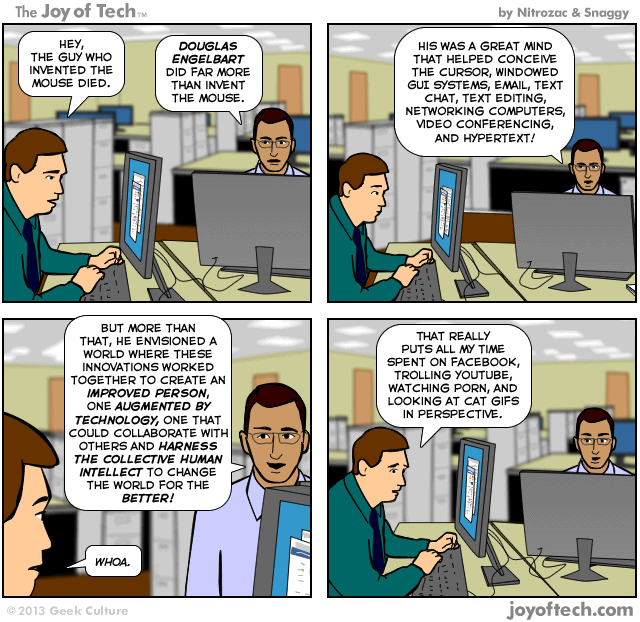
Changing the world for better…
![]() |
| http://www.geekculture.com/joyoftech/joyarchives/1871.htmlhttp://www.geekculture.com/joyoftech/joyarchives/1871.html |
Etiquetas:
culturilla,
curiosidades agradables,
ideas,
informática,
internet,
la vida misma
martes, 9 de julio de 2013
Bottom-Up Business Intelligence
"… We see emergent behavior in systems like ant colonies, when the individual agents in the system pay attention to their immediate neighbors …"
Information Development - Bottom-Up Business Intelligence
“We see emergent behavior in systems like ant colonies,” Johnson explained, “when the individual agents in the system pay attention to their immediate neighbors rather than wait for orders from above. They think locally and act locally, but their collective action produces global behavior.”
“Most discussions of decision making,” Peter Drucker once said, “assume that only senior executives make decisions or that only senior executives’ decisions matter. This is a dangerous mistake.”
“Decisions,” Drucker explained, “are made at every level of the organization, beginning with individual professional contributors and frontline supervisors. These apparently low-level decisions are extremely important in a knowledge-based organization. Knowledge workers are supposed to know more about their areas of specialization—for example, tax accounting—than anybody else, so their decisions are likely to have an impact throughout the company. Making good decisions is a crucial skill at every level. It needs to be taught explicitly to everyone in organizations that are based on knowledge.”
Information Development - Bottom-Up Business Intelligence
“We see emergent behavior in systems like ant colonies,” Johnson explained, “when the individual agents in the system pay attention to their immediate neighbors rather than wait for orders from above. They think locally and act locally, but their collective action produces global behavior.”
“Most discussions of decision making,” Peter Drucker once said, “assume that only senior executives make decisions or that only senior executives’ decisions matter. This is a dangerous mistake.”
“Decisions,” Drucker explained, “are made at every level of the organization, beginning with individual professional contributors and frontline supervisors. These apparently low-level decisions are extremely important in a knowledge-based organization. Knowledge workers are supposed to know more about their areas of specialization—for example, tax accounting—than anybody else, so their decisions are likely to have an impact throughout the company. Making good decisions is a crucial skill at every level. It needs to be taught explicitly to everyone in organizations that are based on knowledge.”
Etiquetas:
cosillas empresariales,
culturilla,
el critico como artista,
ideas,
la vida misma
sábado, 6 de julio de 2013
What Is Resilience? by Brian Walker - Project Syndicate
"…the capacity of a system to absorb disturbance, re-organize, and keep functioning in much the same way as before. :"
What Is Resilience? by Brian Walker - Project Syndicate
A high degree of diversity, especially response diversity (different ways of doing the same thing, often mistakenly thought of as “redundancy”).
A relatively modular structure that does not over-connect its components;.
A strong capacity to respond quickly to change.
Significant “openness,” allowing emigration and immigration of all components (closed systems remain static).
Maintenance of adequate reserves – for example, seed banks in ecosystems or memory in social systems (which speaks against just-in-time supply services).
Encouragement of innovation and creativity.
High social capital, particularly trust, leadership, and social networks.
Adaptive governance (flexible, distributive, and learning-based).
…
What Is Resilience? by Brian Walker - Project Syndicate
A high degree of diversity, especially response diversity (different ways of doing the same thing, often mistakenly thought of as “redundancy”).
A relatively modular structure that does not over-connect its components;.
A strong capacity to respond quickly to change.
Significant “openness,” allowing emigration and immigration of all components (closed systems remain static).
Maintenance of adequate reserves – for example, seed banks in ecosystems or memory in social systems (which speaks against just-in-time supply services).
Encouragement of innovation and creativity.
High social capital, particularly trust, leadership, and social networks.
Adaptive governance (flexible, distributive, and learning-based).
Of course, the need for transformation to create or maintain resilience may also affect the highest scale: If some countries and regions are to remain (or become) resilient social-ecological systems with high human well-being, it may be necessary to transform the global financial system.
Transformation requires getting past denial, creating options for change, and supporting novelty and experimentation. Financial support from higher levels (government) all too often takes the form of help not to change (bailouts of too-big-to-fail banks, for example), rather than help to change.
Resilience, in short, is largely about learning how to change in order not to be changed. Certainty is impossible. The point is to build systems that will be safe when they fail, not to try to build fail-safe systems.
Transformation requires getting past denial, creating options for change, and supporting novelty and experimentation. Financial support from higher levels (government) all too often takes the form of help not to change (bailouts of too-big-to-fail banks, for example), rather than help to change.
Resilience, in short, is largely about learning how to change in order not to be changed. Certainty is impossible. The point is to build systems that will be safe when they fail, not to try to build fail-safe systems.
Etiquetas:
culturilla,
curiosidades agradables,
economía,
hacktivismo,
ideas,
la vida misma
domingo, 30 de junio de 2013
Why RSS Readers and the Choice of a Feed Reader Matters
;-PP “too long; didn’t read” or “tl;dr”
Why RSS Readers and the Choice of a Feed Reader Matters | The CerebralRift
Etiquetas:
culturilla,
ideas,
internet,
lecturas,
social media
Suscribirse a:
Entradas (Atom)